


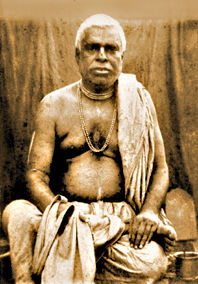
Bhaktivinoda Thakur (1838-1914)
About 500 years ago, in the Nadia district of West Bengal, the ascetic named Chaitanya Mahaprabhu had founded a new branch of the Vaishnava tradition. This Gaudiya-Vaishnava branch became an unseparated part of Bengali spiritual culture. in western countries it is a common mistake to assume this branch (which is now often referred to as "Hare-Krishna" in the west) as some sort of a new-age western movement, when in fact it's roots goes way back into Indian culture.
The spreading of Gaudia-Vaishnavism into the west became known through the street chanting of the Hare-Krishna mantra brought to New-York in the 60's. But not many know that the spreading of Gaudiya-Vaishnavism has history back to the 19th century.
The Sankirtan movement of Chaitanya-Mahaprabhu was meant by him to spread world wide, "in every town and village" in his words. This movement, who was leter developed by Mahaprabhu's deciples, "the Goswamis", prospered through the 16th and 17th century. Then came a decline. A hand few of bonafied Vaishnavas were buried under so many bogus ones and the main writings of this branch became rear items. But then, at the second half of the 19th century, Gaudiya-Vaishnavism spread like never before, all thanks to the foundations settled by one grate scholar name Bhaktivinoda Thakur.
Bhaktivinoda Thakur was born in 1838 at the district of Nadia, the very same land where Mahaprabhu's movement started. But be may so, his family were not Vaishnavas and some of them were not even sympathizers of the Vaishnava branch. Bhaktivinoda was received with a modern education in English schools. Later, as a young student in Calcutta, he showed grate interest in western culture as shown in his book "The Poriade", the story of Porus meeting with Alexander the grate. In a later period of his life he even founded the first English school in the state of Orrisa.
The 19th century in this area of India, under British occupation, was also the time of the Bengali Renaissance, when many Hindu scholars and spiritual leaders were influenced by western values. Scholars such as Swami Vivekananda, disciple of Sri Ramakrishna Paramahamsa, who presented a modern neo-hinduist philosophy influenced by admiration of British culture. Bhaktivinoda was also influenced by western theology at the time. As a young student, being under the impression that Hinduism revolves around the notion of Adveita-Vedantic "all is one" perception, he thought the Christian bible to be more suitable, as it shows a conception of God as a person. This admiration of Bhaktivinoda to the Bible never went away and is shown in his later articles.
Eventually, after investigating all the philosophies common in the area, Bhaktivinoda came to a conclusion that out of all the philosophies developed in west Bengal, only the branch of Chaitanya-Mahaprabhu is genuine. Later he became a disciple of Jaganath das Babaji, a guru in the line of Chaitanya Mahaprabhu.

The temple Bhaktivinoda and his son Bhaktisidhanta lived in
In 1961 Bhaktivinoda accepted the post of deputy magistrate of West-Bengal. In this service for a long period lasted most of his life he fought against corruption and injustice through the country. A verry famous tale told by his disciples is how he brought to justice a bogus guru from the area of Orrisa who claimed to be God and used his authority to molest young girls. All through his service in his government post, Bhaktivinoda, a family man, did not neglected his study of theology and Vaishnava philosophy. He searched for rear copies of writings by the Goswamis and written many poems, books and articles, many of them in English. While many misrepresenting ideas about vedic philosophy were spreading through the west, Bhaktivinoda published English translations to scriptures and sent them to western universities. He wrought many books representing Indian philosophy, such as his book Jiva-Dharma, written as a novel. He wrought English books explaining the philosophy of Mahaprabhu, such as "Caitanya Manaprabhu, His life and precepts". This was all done in the attempt to do the bidding of Mahaprabhu himself, spreading Vaishnava philosophy all through the world. Along with his guru, Jaganath das Babaji, Bhaktivinoda founded the Yoga-Pith temple in Mayapur, stating the birth place of Chaitanya Mahaprabhu.
 Yoga-Pith, birth place of Chaitanya Mahaprabhu
Through his life, Bhaktivinoda was a family man and served his duties for the public in his government post. And then, in the last few years of his life he decided to retire. 6 years before his death he took initiation as a Babaji, an ascetic hermit. And then, at 1914, Bhaktivinoda Thakur entered an eternal Samadhi as he finally left his body. Bhaktivinoda's son, Bhaktisidhanta Sarasvati, latter continued in his fathers spirit when he established the Gaudiya-Math society, the first Gaudiya-Vaishnava organization to ever actually spread it's teaching in the west and make western disciples. This attempt to spread this philosophy in the beginning of the 20th century had later inspired organizations such as ISKCON, founded by Bhaktivedhanta Swami in New York during the 60's, and Chaitanya Sarasvati Math, founded by B.S Govinda Maharaj, and many other disciples of Bhaktisidhanta who did the same. Every westerner who is inspired by Vaishnava philosophy and the chanting of Hare-Krishna, should pay his gratitude to Bhaktivinoda Thakur. Bhaktivinoda was indeed a Vaishnava Pioneer.
For more information:
http://www.salagram.net/parishad116.htm
http://en.wikipedia.org/wiki/Bhaktivinoda_Thakur


