Sunday, December 23, 2007

The demon who drive people mad

The evil king Kamsa made a plot for killing baby Krishna who was safely hidden in the village of Vrindavan. And so he hired the service of an evil she demon called Putana, who was an expert in killing babies. The she demon Putana took the form of a beautiful woman and went to baby Krishna's room. The Gopies, the cowheard girls of the village, had simply let her in. To them she seemed so beautiful and motherly. Who would of thought it's an evil demon? So the she demon Putana simply entered the room where Krishna was in. And that baby was no other then the one residing in our hart. God himself who is the goal of every spiritual aspirant. And that is something you might want to protect with everything you have. And no spiritual aspirant is as devoted as the Gopies. And yet they made such a mortal mistake and let the killer of the spiritual into the room, a deed who's doer shell fall into the depth of hell, as described in Isa-Upanishad (verse 3). How can that be?
Actually, we see that mistake being made by so many spiritual aspirants who simply gives themselves to a bogus guru. Simply because he appear nice, saying sweet words, smiles allot and repeatedly say the words "love" and "truth" they think the bogus guru is real. "How can someone appearing so nice be bogus? He is so full of love! he is my friend!" And so they fall into hell.
The power of the Putana demon lies not in the Poisson in her breasts, but in her lovely smile,her power to bewilder the mind of the Gopies to think she is a friend and not the killer of the soul. And that is why the Bhagvatam (10.6.27-29) Putana is mentioned as "one who drive people mad" and "One who bewilder the memory". What is Putana's Poisson? It is falls knowledge. What is the lovely form she had taken? It is the smile of the bogus guru. And as Bhaktisiddhanta Sarasvati Takura told, this Putana may be found in so many temples and churches, giving away her Poisson, sometimes as "love", sometime as "yoga", sometimes as "truth".
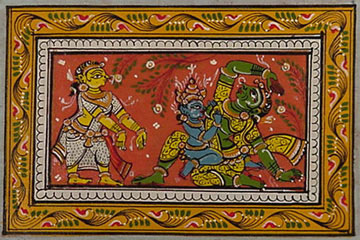
And in this way, looking so beautiful and holding a lotus in her hand, the she demon Putana entered the child's room and took him in her hands. She then fed him with her poison milk. Yet along with the poison he sucked her life out, and by so her real monstrous form was exposed to the eyes of all the people of Vrindavan. By that lord who dwells in our hart, the demon was killed.
Krishna Kills Putana

Friday, December 21, 2007

A Family for the Gita

A new comics of mine at ISKCON Desire Tree. The story of "A Family for the Gita" by Bhaktisidhanta Sarasvati.

Tuesday, December 4, 2007

About anger

A poet once wrote a very wise phrase in hindi: "A person without judgment must never act hastily in anger, and by so may prevent a disaster". A king was passing by and saw that phrase and thought it was a verry inspiring thing. And so the king had the phrase inscribed on a golden plate and hanged by his bad.
One day the king came home and entered his bedroom where a very disturbing sight was discovered there before his eyes: His dear wife, which he loved more then anything in the world, was laying on the bed sleeping. and in her arms was a young man, also sleeping. The king, filled with anger, quickly puled out his sword, about to strike the unfaithful wife and her young lover and kill them in their sleep. And then, as he raised his sword, he suddenly saw a flash from the golden plate by his bad and reminded: "I must not act in anger! Never in anger!"
Gently he approached the bed and woke his wife. The wife immediately called: "Husband! The most wonderful thing happened to us today! The son we've lost years ago, when he was just a baby, has come home! And there he is, by now a young man!"
Just imagine the thoughts the king had as he realized the disaster just prevented. And all thank to those inspiring words of wisdom. He immediately summoned the poet to his palace and gave him the respect he so deserve.
What is the problem with action in anger? It is it's feature of distorting our judgment, our perception of reality. As mentioned it the Gita: "From anger, delusion arise" ("krodhād bhavati sammohah" 2:63). Why is that? Because anger set our center in the self, which is a false reality. Vedic philosophy sets a model of reality in which there is one center, which is Bhagavan. The natural state of things would be to revolve around that center. If one choose to revolve around himself, that would be a false reality. It is the desire to be God, to be in control. And anger is all about control. And so, out of anger, the delusion of control arise, and so the perception of reality becomes twisted. That is why the scriptures sets anger as one of the three gates to hell (greed, lust and anger). It's not just happen that the Jewish scriptures state that one who is angry it's as if worshiping false gods (Talmud, Shabat 105:2).
What about spiritual anger? is there such thing? Yes indeed! The Ramayan tells us of such anger. The anger of Hanuman the monkey, servant of Rama, who set fire into the city of Lanka. Is my anger can be considered "spiritual"? A tempting thing to consider. Let us investigate that idea: Hanuman's anger was spiritual since it revolved around the service of Rama. Meaning, the center point was not the self, but Bhagavan. Can I truly say my anger is as such? Can I truly say it's about service, not control?

Thursday, November 8, 2007

The story of an offence

One day in Vrindavan, the grate saint Sri Rupa Goswami had a visit from a grate scholar of a different school of Vaishnavism. The two sat down and, as customary between vedic scholars, had a conversation about spiritual subjects. Sri Jiva Goswami, the nephew of Sri Rupa, was also present, listening to the conversation. At some point, Sri Rupa suggested his own commentary on a cirtin topic to the scholar, at which point the gap between the two philosophies had arise. The scholar politely commented to Sri Rupa that it is to his opinion that this commentary was wrong. While Sri Rupa took no offense to this comment, Sri Jiva could not bear such criticism against the doctrine of his friend and teacher. Out of respect, Sri Jiva remained silent, not disturbing the conversation.
It was later that day when Sri Jiva could not bear it no more. Knowing the scholar went to bath in the river, Sri Jiva decided to go there to get some water. Then he decided to take the chance and explain to the scholar his mistake. After the conversation, the scholar was indeed impressed by the knowledge of the young swami. A few days after, when he re encountered Sri Jiva Goswami, the scholars praised the young Sri Jiva in his ears, describing their conversation by the river. Though the scholar seemed very pleased, Sri Rupa was indeed unpleased. And after the the departure of the scholar, he called his disciple Sri Jiva and had a conversation with him. "You're act was unpolite" he said. "When engaged in a philosophical conversation, we should first consider the other side as our Guru to whom we bow down to. Only after such respect is offered should we debate as equals." And then Sri Rupa said: "Return home now. Leave Vrindavan until the day you'll be able to show more control."
So tormented was Sri Jiva by this instruction. He wondered around the roads lamenting his separation from his master and the land of Vrindavan. Then one day Sri Rupa's brother, Sri Sanatana Goswami found him in a temple at Nanda-Ghat, weak from days of fasting and crying. He took Sri Jiva back to Vrindavan where Sri Rupa Goswami was glad to welcome him back.
"Om! May God protect us both together by showing us the way through knowledge. May He sustain us both by that knowledge. May we attain that knowledge together. Let what we learn enlighten us. And may we not quarrel among ourselves. Om Peace Peace Peace!"
(The Upanishads)
Samadhi Mandir of Sri Rupa Goswami
Radha-Damodara temple - Vrindavan, India

Tuesday, October 30, 2007

Trying to hug the truth

I've been around the western "new-age"/commercial-spirituality scene for some time. Around this scene you can find so many classes, people and books presenting their version of eastern philosophy and ancient cultures. Often you'll find among those a vary sad reality in which truth moves aside, making way to commercialism. You find teachers who dismiss legitimate criticism on their teachings simply by arguments such as "you're thinking too much " or "you're not open to new ideas". You'll find people clinging to ideas they find pleasant even when they are proven wrong, simply by the notion of "all is one" and "what the blip do we know". When asked to present valid arguments against the disproofs they simply reply that knowledge is irrelevant and simply "feeling" that it is true is enough for them. Such a notion of "knowledge is ignorance" is so very common among the neo-hinduists/neo-budhists/neo-native-americans of the west. These western followers of the orient will be very sad to hear that grate personalities such as Shankara and Buddha, the ones they respect as spiritual masters, would have shown no support whatsoever in such ideas. It is quite obvious from looking in their writings that those thinkers were indeed philosophers. They came from a culture of logical debates in an attempt to reach conclusions, seek truths through philosophical inquiry. To arguments such as "it's true because I feel it" the real, historical, Buddha would probably reply: "well then, you're a cheater!" and walk away. Postmodernism was not common these days and no one would have even think of following a guru who's ideas were disproof in front of followers eyes.
But, of course, there is a grate gap between the historical Buddha and the western Buddha "logo" of the new-age culture. Instead of showing you the truth of his teachings, he tries to drag you into it. He uses the weapon of charisma rather then the light of truth presented by the original one in public debates. Sometime, when you tell him you disagree, he tells you you are not open to new ideas. How can you disagree now? You don't want to be consider narrow minded, do you? Or sometimes he simply smiles and tells you you have to follow your hart, when in fact he wants you to follow his hart after he bought your trust with his smile. His followers are victimised indeed, but have only themselves to blame. Simply because they choose to accept a simple incorrect equation: if he smiles, then his words are true. This equation is, of course, untrue. What I say here may seem a bit harsh and some of the readers may choose to ignore such criticism and choose a softer notion instead. Well, that is exactly what I'm talking about! Just because a word is not pleasant to them, they define it as untrue. Is that a valid conclusion? Is it so hard to smile, be nice to people and say the word "love" in each sentence? Do you have to be "enlighten" to be able to do so? Well then, what makes you think there's no one using these things to sell you ideas? Common salesmen do it all the time, don't they?
This is what the Katha-Upanishad means by saying: "One path is pleasant and the other is good. The wise should choose the good" (1.2.1). It is indeed very tempting to accept the words of the one who hugs you rather then strain your head a little and try to think a little bit more. I do think that many of these "love"/"all is one" theories are based less on love and more on laziness. Truth demands hard work. To think, to read books, to successfully confront counter arguments. In a culture that sets escapism and mass-media as its ultimate goal, it is very easy to just let go of all the hard work and simply declare "all is one" and we don't need to think. In other words: laziness.
Sometimes the spiritual seeker should be harsh. Always he should insist on valid conclusions. No, it is not disrespective. On the contrary: it is the biggest respect among intellectuals. Was the Buddha disrespective when he attended public debates with counter schools? Was Shankara? Ramanuja? Madhavacharya? Patanjali? No, there is nothing wrong in following valid conclusions, and don't let anyone tell you otherwise. No, it is not a sin to tell you're guru, master or yoga instructor you see an apparent faults in his teachings and ask him to explain them. Remember the words of the Bhagavad-Gita: "Just try to learn the truth by approaching a spiritual master, serve him and inquire him submissively. One who have witnessed the Truth can show it to you" (4.34). Look carefully on this quote: "Inquire him submissively". Be submissive, be respectful, yes. Always. But also inquire. Ask him. See if he has a valid logical conclusion to each and every point.If he's for real, he will answer. And if he avoid you're question, saying you should stop thinking too much or that your just being narrow minded, well, then you no longer have to be submissive. Be alert. If you read George Orwell you should know "Knowledge is ignorance" is a slogan that can be used to control you. Serve as a disciple only if he serves as a guru.
Letting go from your mind is not freedom. It'll turn you into a slave in the hands of cheaters. The mind is not you're enemy as long as it's controlled. And controlling you're mind means making it follow valid conclusions rather then whimsical desires. And the desire to cheat and be cheated is one of the most dangerous ones. Can love not be the way? Or no-mind? I'm not saying it is and I'm not saying it isn't. But the way to finding weather they are must go through logical proof. Through the mind. Only when you see the road you should start walking in it. And you see with your eyes, not your feet.
I'm not saying that the "hugging guru" can't be true. I'm not saying that every nice guy who talks about peace and love is a cheater. He doesn't have to be. Just as long as he follows certain rules. As long as he is honest and is very strict about intellectual integrity. "Truth is God" said Gandhi. If you want to reach God, worship the truth.


Saturday, October 27, 2007

Kartika

The month of Kartika has started.
This month is much recommended for going on pilgrimage to holly places and temples.
It is very recommended on this month to worship Krishna's image as Sri Damudara and chant the Damodarastaka prayer found in Padma-Purana.

SRI DAMODARASTAKA

(found in the Padma Purana of Krsna Dvaipayana Vyasa, spoken by Satyavrata Muni in a conversation with Narada Muni and Saunaka Rsi.)

"In the month of Kartika one should worship Lord Damodara and daily recite the prayer known as Damodarastaka, which has been spoken by the sage Satyavrata and which attracts Lord Damodara." (Sri Hari-bhakti-vilasa 2.16.198)
(1)
namamisvaram sac-cid-ananda-rupam
lasat-kundalam gokule bhrajamanam
yasoda-bhiyolukhalad dhavamanam
paramrstam atyantato drutya gopya

(1) To the Supreme Lord, whose form is the embodiment of eternal existence, knowledge, and bliss, whose shark-shaped earrings are swinging to and fro, who is beautifully shining in the divine realm of Gokula, who [due to the offense of breaking the pot of yogurt that His mother was churning into butter and then stealing the butter that was kept hanging from a swing] is quickly running from the wooden grinding mortar in fear of mother Yasoda, but who has been caught from behind by her who ran after Him with greater speed - to that Supreme Lord, Sri Damodara, I offer my humble obeisances.

(2)
rudantam muhur netra-yugmam mrjantam
karambhoja-yugmena satanka-netram
muhuh svasa-kampa-trirekhanka-kantha-
sthita-graivam damodaram bhakti-baddham

(2) [Seeing the whipping stick in His mother's hand,] He is crying and rubbing His eyes again and again with His two lotus hands. His eyes are filled with fear, and the necklace of pearls around His neck, which is marked with three lines like a conchshell, is shaking because of His quick breathing due to crying. To this Supreme Lord, Sri Damodara, whose belly is bound not with ropes but with His mother's pure love, I offer my humble obeisances.

(3)
itidrk sva-lilabhir ananda-kunde
sva-ghosam nimajjantam akhyapayantam
tadiyesita-jnesu bhaktair jitatvam
punah prematas tam satavrtti vande

(3) By such childhood pastimes as this He is drowning the inhabitants of Gokula in pools of ecstasy, and is revealing to those devotees who are absorbed in knowledge of His supreme majesty and opulence that He is only conquered by devotees whose pure love is imbued with intimacy and is free from all conceptions of awe and reverence. With great love I again offer my obeisances to Lord Damodara hundreds and hundreds of times.

(4)
varam deva moksam na moksavadhim va
na canyam vrne 'ham varesad apiha
idam te vapur natha gopala-balam
sada me manasy avirastam kim anyaih

(4) 0 Lord, although You are able to give all kinds of benedictions, I do not pray to You for the boon of impersonal liberation, nor the highest liberation of eternal life in Vaikuntha, nor any other boon [which may be obtained by executing the nine processes of bhakti]. O Lord, I simply wish that this form of Yours as Bala Gopala in Vrndavana may ever be manifest in my heart, for what is the use to me of any other boon besides this?
(5)
idam te mukhambhojam atyanta-nilair
vrtam kuntalaih snigdha-raktais ca gopya
muhus cumbitam bimba-raktadharam me
manasy avirastam alam laksa-labhaih

(5) 0 Lord, Your lotus face, which is encircled by locks of soft black hair tinged with red, is kissed again and again by Mother Yasoda, and Your lips are reddish like the bimba fruit. May this beautiful vision of Your lotus face be ever manifest in my heart. Thousands and thousands of other benedictions are of no use to me.

(6)
namo deva damodarananta visno
prasida prabho duhkha-jalabdhi-magnam
krpa-drsti-vrstyati-dinam batanu
grhanesa mam ajnam edhy aksi-drsyah

(6) 0 Supreme Godhead, I offer my obeisances unto You. O Damodara! O Ananta! O Visnu! O master! O my Lord, be pleased upon me. By showering Your glance of mercy upon me, deliver this poor ignorant fool who is immersed in an ocean of worldly sorrows, and become visible to my eyes.

(7)
kuveratmajau baddha-murtyaiva yadvat
tvaya mocitau bhakti-bhajau krtau ca
tatha prema-bhaktim svakam me prayaccha
na mokse graho me 'sti damodareha

(7) 0 Lord Damodara, just as the two sons of Kuvera - Manigriva and Nalakuvara - were delivered from the curse of Narada and made into great devotees by You in Your form as a baby tied with rope to a wooden grinding mortar, in the same way, please give to me Your own prema-bhakti. I only long for this and have no desire for any kind of liberation.

(8)
namas te 'stu damne sphurad-dipti-dhamne
tvadiyodarayatha visvasya dhamne
namo radhikayai tvadiya-priyayai
namo 'nanta-lilaya devaya tubhyam

(8) 0 Lord Damodara, I first of all offer my obeisances to the brilliantly effulgent rope which binds Your belly. I then offer my obeisances to Your belly, which is the abode of the entire universe. I humbly bow down to Your most beloved Srimati Radharani, and I offer all obeisances to You, the Supreme Lord, who displays unlimited pastimes.

Thursday, October 25, 2007

The appearance of Lakshmi Devi

Lakshmi Devi is a Divine personality who always serves the lord's feet. As Vishnus mate, the also has the power to give everyone wealth, being the power of wealth and fortune. That power is pursued by most people, but not in a good way.

Once the Devas and the Asuras, the good and evil forces of the universe, declared a truth in order to churn a life giving nectar out of an ocean of milk. Vishnu, the supreme person himself, brought a grate mountain called Mandara to serve as a churning rod. Vasuki, the king of snakes, wrapped his grate body around the mountain and the two groups were to pull on the two ends like a rope for the churning. But then the Asuras, the proud lustful demons, had a complaint: "why should we grab on the snakes backside and not the head? Let us have the head and you the back!" So proud were they. But Vishnu Bhagavan, in grate humility and with a smiley face, let them have the front. And during the churning, the Asuras suffered a grate deal from the fire coming from the serpent's thousands of mouths. Such are the choices of materialistic people, going after what seems pleasant and not what is right. And thus it is said "The good is one thing, the pleasurable is another. They lead to different places. The wise man choose the good while the one who choose the pleasurable shell not reach his goal." (Katha-Upanishad 2.1.1)

And with the life giving nectar thus churned, also manifested Lakshmi as a beautiful woman. Knowing her to be a grate devotee of God, the Devas hurry to give her their respect, worship her and chant prayers, while the Asuras quarreled over the nectar, pursuing eternal life. They also were envy of the Devas and their relations with Lakshmi. In the end, the Devas got the nectar as well while the asuras did not get anything. (You can read the full story in Shrimad Bhagvatam kanto 8)

Some believe that in order to advance spiritually one must renounce the world completely. It is, in fact, not true. The world and the forces of nature are, in fact, the lords energy. All the Devas represent a certain power of nature and those are grate servants of the lord. Lakshmi represents the power of wealth and fortune. It is not renunciation from it that the yogi should seek, but detachment. When a person is attached to a certain thing of the world, such as wealth of pleasure of the senses, it is materialism. It is worshiping a Deva as a separate "God". But a Vaishnava worships Bhagavan, the supreme personality. God. And thuse he worships the Devas as his servants and all living things as his children. And thus love of God becomes love of all.

"In human society there are various activities performed for the protection of one's wealth and life by one's words, one's mind and one's actions, but they are all performed for one's personal or extended sense gratification with reference to the body. All these activities are baffled because of being separate from devotional service. But when the same activities are performed for the satisfaction of the Lord, the beneficial results are distributed to everyone, just as water poured on the root of a tree is distributed throughout the entire tree."

(Srimad-Bhagvatam 9.8.9)

Thursday, October 18, 2007

Mistress of illusion

Yesterday was Durga-Puja, a celebration in honor of Durga, the cosmic mother, personification of the material potency. Also known as Maha-Maya, "The Grate Mistress of Illusion".
Devi-Mahatmaya is a scripture in honor of Durga. It is said that anyone who reads it will have the blessing of the holly mother such as fortune and wealth. Such worship of Durga is meant for people who are attached to material things. But like all Vedic scriptures, it also gradually elevates people towards the Divine.
The Devi-Mahatmayam begins with the story of a king who was betrayed by his people and lost his kingdom. On his way, he ran across a householder who was betrayed by his family and lost all he had. As they talk, they realize they both are still attracted to the things they lost. The king is still longing to his kingdom and the householder still has feelings for those who betrayed him. Such a nasty senseless attraction for both intelligent man, both king and commoner aren't amuned to. Together they try to find out why do they have such an irrational attraction. They approach sage Sumedhas asking him why do they have this problem, and the sages answer was conclusive: it is Maya, the mistress of illusion, who is making all being after what they shouldn't be after". And then the sage started to tell them the story of that grate Devi.
According to the Vedic narrative, all that is comes from the one. God. Brahman. Param-Brahman, the supreme, is known by many names such as Narayan or Vishnu and also has many incarnations. In a small corner of his domain, lays the material creation. But most of what is, is actually the spiritual creation. In the material creation Vishnu lays down in a mystic sleep: Yoga-Nidra. At the same time he is in the spiritual world, having relationships with the souls who are there, he is also in his Yoga-Nidra sleep in the material corner of his domain. And out of that sleep, the material universes are manifested. You might say that this whole world is God's dream. And if so, Durga is his sleep. She is the very force that is manifested as the material worlds, those very same worlds in that corner of creation meant for those who chose to be apart from God, just to fulfill their desires, just until they'll choose to return home to their heavenly father.
And in this material world there are many things to attract the mind and senses. So many things that seems beautiful, hiding the fact that it is no more then one big cosmic jail. And Maya, the mistress of illusion, is guarding it's gates. By her we are trapped here. But by her mercy we can also be free from this illusion and see the supreme truth (Sanatan-Dharma). For she is the grate servant of him, the supreme lord. And in the spiritual realm she also has a form. In here she is Maha-Maya, but there she is Yoga-Maya. In here she constructs the entire world of illusion, making us forged the lord and our eternal relationship with him. But in the spiritual world, as Yoga-Maya, she helps us forget the lord's greatness so we could have a close relationship with him. Forget the lord's gratness? is that a good or a bad thing?
In the Bhagavad-Gita the lord appears as Krishna to his devotee Arjuna. They have a close relationship as friends, which is the goal of the spiritual practitioners and yogis. Arjuna is acting as the lord's friend, unaware of his supreme universal form. And then, upon his request, Krishna revels that grate universal form to Arjuna, which Arjuna finds very disturbing. How can you have a close relationship with something that grate? How can you be his friend? And so Arjuna request the lord to take back his original form as his dear friend, lord Krishna.
Also, in the Srimad-Bhagvatam it is told how Krishna appeared on earth as the child of Vasudeva and Devaki. At first, when he was born, he took his majestic form of Vishnu. But then, upon the parents request, he took the form of Gopal, the sweet baby Krishna. For only in such a form they could have a close relationship with him as their child. So sometimes, spirituality is not about seeing God as the all mighty in his greatness (even though he is), but also about forgetting this greatness. And Yoga-Maya makes it possible.
Krishna appeared on earth to Vasudeva and Devaki who were immediately persecuted by the evil king Kamsa. And then the grate mother Maya appeared there and Kamsa became so frightened. In this world she is the grate mother Durga, holding all the wepons given to her by all the celestial rulers, just to show she manifests all their strength. Like fire, she is riding a tiger through the battle filed, destroying the enemy. As such, we should pray to that grate mother Durga to destroy our illusion and bad habits, so that we'll no longer have obstacles in our spiritual path.

Maha-Maya in Vrindavan

Tuesday, October 2, 2007

Licking the wounds of the enemy

In Vedic scriptures, the world is often compered to a battle field and the self to a warrior. The process of Yoga, spiritual progress, is compered to a battle. So is the case in the Bhagavad-Gita where Arjuna comes face to face with his inner demons before actually going to battle. He finds out that defeating these demons may be more complicated then he thought and that he may have left himself unguarded in places he should. And here is another description of a battle:
An historical tale is told in the Devi Mhatmya about Mother Durga who was in battle against a terrible demon called Raktabija ("one who's blood is seed"). No matter how many time she wounded the demon, she could not defeat him, for that demon had a unique ability: every drop of his blood that falls to the ground would turn to a replica of the demon. Every time the mother strike the demon with one of her weapons, the drops of blood who fall to the ground would immediately turn to more enemies for her to fight. How can you defeat such a demon? in fact, if you look around you, and maybe inside you, you'll find there are many of these Raktabija demons around. You fight them, and they get stronger. They seem to be undefeated. That is the demon Mother Durga fought. But then the Divine mother found a way to defeat the demon: She expanded herself to another form of her, Kali, the black mother. Kali-Ma has a terrible dark form, holding weapons and wearing a garland of skulls. The dark mother then reached out her long tongue and start licking the demon's wounds, preventing the blood from reaching the ground. And in this way the demons deadly ability was prevented. And thous, by the licking of his wounds the demon was defeated, rather then striking him harder. You may use this information to defeate the Rakabija demons in your life.

A small Kali shrine I found in a small village in West-Bengal

Monday, September 24, 2007

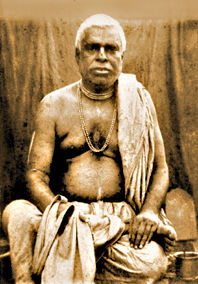
Bhaktivinoda Thakur – A Vaishnava Pioneer


Bhaktivinoda Thakur (1838-1914)

About 500 years ago, in the Nadia district of West Bengal, the ascetic named Chaitanya Mahaprabhu had founded a new branch of the Vaishnava tradition. This Gaudiya-Vaishnava branch became an unseparated part of Bengali spiritual culture. in western countries it is a common mistake to assume this branch (which is now often referred to as "Hare-Krishna" in the west) as some sort of a new-age western movement, when in fact it's roots goes way back into Indian culture.
The spreading of Gaudia-Vaishnavism into the west became known through the street chanting of the Hare-Krishna mantra brought to New-York in the 60's. But not many know that the spreading of Gaudiya-Vaishnavism has history back to the 19th century.
The Sankirtan movement of Chaitanya-Mahaprabhu was meant by him to spread world wide, "in every town and village" in his words. This movement, who was leter developed by Mahaprabhu's deciples, "the Goswamis", prospered through the 16th and 17th century. Then came a decline. A hand few of bonafied Vaishnavas were buried under so many bogus ones and the main writings of this branch became rear items. But then, at the second half of the 19th century, Gaudiya-Vaishnavism spread like never before, all thanks to the foundations settled by one grate scholar name Bhaktivinoda Thakur.
Bhaktivinoda Thakur was born in 1838 at the district of Nadia, the very same land where Mahaprabhu's movement started. But be may so, his family were not Vaishnavas and some of them were not even sympathizers of the Vaishnava branch. Bhaktivinoda was received with a modern education in English schools. Later, as a young student in Calcutta, he showed grate interest in western culture as shown in his book "The Poriade", the story of Porus meeting with Alexander the grate. In a later period of his life he even founded the first English school in the state of Orrisa.
The 19th century in this area of India, under British occupation, was also the time of the Bengali Renaissance, when many Hindu scholars and spiritual leaders were influenced by western values. Scholars such as Swami Vivekananda, disciple of Sri Ramakrishna Paramahamsa, who presented a modern neo-hinduist philosophy influenced by admiration of British culture. Bhaktivinoda was also influenced by western theology at the time. As a young student, being under the impression that Hinduism revolves around the notion of Adveita-Vedantic "all is one" perception, he thought the Christian bible to be more suitable, as it shows a conception of God as a person. This admiration of Bhaktivinoda to the Bible never went away and is shown in his later articles.
Eventually, after investigating all the philosophies common in the area, Bhaktivinoda came to a conclusion that out of all the philosophies developed in west Bengal, only the branch of Chaitanya-Mahaprabhu is genuine. Later he became a disciple of Jaganath das Babaji, a guru in the line of Chaitanya Mahaprabhu.

The temple Bhaktivinoda and his son Bhaktisidhanta lived in

Nadia district - West-Bengal

In 1961 Bhaktivinoda accepted the post of deputy magistrate of West-Bengal. In this service for a long period lasted most of his life he fought against corruption and injustice through the country. A verry famous tale told by his disciples is how he brought to justice a bogus guru from the area of Orrisa who claimed to be God and used his authority to molest young girls. All through his service in his government post, Bhaktivinoda, a family man, did not neglected his study of theology and Vaishnava philosophy. He searched for rear copies of writings by the Goswamis and written many poems, books and articles, many of them in English. While many misrepresenting ideas about vedic philosophy were spreading through the west, Bhaktivinoda published English translations to scriptures and sent them to western universities. He wrought many books representing Indian philosophy, such as his book Jiva-Dharma, written as a novel. He wrought English books explaining the philosophy of Mahaprabhu, such as "Caitanya Manaprabhu, His life and precepts". This was all done in the attempt to do the bidding of Mahaprabhu himself, spreading Vaishnava philosophy all through the world. Along with his guru, Jaganath das Babaji, Bhaktivinoda founded the Yoga-Pith temple in Mayapur, stating the birth place of Chaitanya Mahaprabhu.

Yoga-Pith, birth place of Chaitanya Mahaprabhu

Through his life, Bhaktivinoda was a family man and served his duties for the public in his government post. And then, in the last few years of his life he decided to retire. 6 years before his death he took initiation as a Babaji, an ascetic hermit. And then, at 1914, Bhaktivinoda Thakur entered an eternal Samadhi as he finally left his body. Bhaktivinoda's son, Bhaktisidhanta Sarasvati, latter continued in his fathers spirit when he established the Gaudiya-Math society, the first Gaudiya-Vaishnava organization to ever actually spread it's teaching in the west and make western disciples. This attempt to spread this philosophy in the beginning of the 20th century had later inspired organizations such as ISKCON, founded by Bhaktivedhanta Swami in New York during the 60's, and Chaitanya Sarasvati Math, founded by B.S Govinda Maharaj, and many other disciples of Bhaktisidhanta who did the same. Every westerner who is inspired by Vaishnava philosophy and the chanting of Hare-Krishna, should pay his gratitude to Bhaktivinoda Thakur. Bhaktivinoda was indeed a Vaishnava Pioneer.


For more information:
http://www.salagram.net/parishad116.htm
http://en.wikipedia.org/wiki/Bhaktivinoda_Thakur

Tuesday, September 18, 2007

Religion VS A Higher Truth

A small Goddess shrine - New-Delhi

I often come across the dilemma weather Gaudiya-Vaishnavism (Krishna Consciousness, "Hare-Krishna") is a religion or not. Considering the fact that it revolves around God, our relationship with the supreme and meditation on God as a person, the common assumption is that this philosophy is a religion. It seems that once God is involved most people would consider the subject matter a religion. This assumption is clearly incorrect. Buddhism is a religion without god and so is Jainism. But from the other hand we cannot just define every mystic or spiritual persuasion as a religion. The first question should be: what is the definition of religion?
When we think of a religion we often think of a prophet talking to a large crowd of people, one such as Jesus or Moses talking to the people from a mountain top. Not so is the case with Vedic spiritual leaders such as Shankara, Ramanuja or Chaitanya. Though they are sometimes referred to as religious figures, they in fact show more of the symptoms of philosophers rather then prophets. If you look at the teachings of lord Chaitanya, as presented in writings such as the Chaitanya-Chaitamrita, you'll find him having deep conversations with other scholars such as Sarvabhoma Bhatacharya, presenting valid arguments and thus establishing his teachings. This is the standard presented by vedic scholars. Religious figures, on the other hand, present instructions that demands faith rather then logical proofs. Not that religious leader such as Moses and Jesus had philosophical base for their teachings and not that their scripture, if you take a second look at them, have no deeper spiritual meaning (usually discovered later by religious scholars). Though there is a class of educated theologians in every religion, the congregations of all religions consist mostly of masses of people who never considered deep philosophical questions.
Sri Chaitanya Mahaprabhu (1486-1534)
Founder of Gaudia-Vaishnavism ("Hare-Krishna)

For example: when I was in West-Bengal I've notices a picture of a local saint presented on stores, houses, taxi cabs and so on. When I asked who is this man, everyone know his name to tell me. But when I asked what did he do and why do you have his picture, all they could tell me is that he was a grate man. So is the case of all religions. Most Buddhists go to temples praying the Buddha and Buddhisatvas for material wealth, not showing much interest in the Buddhist teachings, which are in fact much deeper. So is the case for most Christians, Jews and Muslims and Hindus. It is also worth mentioning that there are also a grate deal of people in India who consider Gaudiya-Vaishnavism as their "religion", defining it as a branch of Hinduism.
To the spiritual aspirant there are no religions. To him there is only truth and the way to it. Also, if you look at the teachings of transcendentalists, such as lord Chaitanya, you'll find ouy not only that the activities they encouraged were on different level then religion, but that they also apposed organized religion in many ways. Offering an unorthodox interpretation of scriptures, reducing the emphasis on ritualism and apposing the cast system, those were principles spread by Chaitanya and others like him.
Is religion a bad thing? Not at all. It is simply one of the many branches of activity in our life. And like all of them, it two can become spiritualized. All religions have the everyday level as well as the higher levels. The everyday level includes material activities. The higher level is where the scriptures show us a higher purpose. One that will eventually shell free the aspirant from material bounds and let him gain enlightenment. At this level he is detached from all mundane things, including material forms of religion. As it said by lord Krishna in the Bhagavad-Gita: (18.66) "Abandon all forms of drarma (religion, truth) and give in to me"

Monday, September 17, 2007

A Manifesto / A word to you, the reader

Why did I open this blog?
Once in a while I get an Idea. Could be at home, could be at work, could be in bed of while I'm reading. Could be while I'm going out for a minute for fresh air (get lot's of idea this way). I develop it in my head and if I won't write it down it may be lost forever. That's why I'm going to write here. And why is that? Becous an idea that was never expressed or exhibited is simply barren.
Through years of Art College I came to the conclusion that what makes an art piece what it is is its audience. A poem written and then put in the poet's pocket is might as well kept in his head and never written. There is really no difference between painting a picture on canvas and painting it in your imagination. Unless, of course, it is exhibited.
Hence my conclusion: you, the readers, are the ones who give life to my creation. I am merely a labor. A carrier bringing it to you. If it wasn’t for you, non of what you see here (or will see, depends on the point of time you are reading this entry) would ever come to existence. It would've remain nothing more then a thought. Then please: read and, if possible, comment.

Thenk you.